
The 2026 power-unit reset got most of the pre-season attention - half-electric power, no MGU-H, sustainable fuel. But the change drivers talk about most isn’t under the engine cover. It’s the wings. For the first time, the bodywork that makes downforce moves on purpose, on every lap, on both axles of the car. DRS is gone. This is what took its place.
Why the wings had to move
The 2026 power unit leans on electrical energy for roughly half its output, and a battery only holds so much. Deploy 350 kW down every straight and you run dry before the lap is done. The fix the regulations chose was aerodynamic: let the car shed drag on the straights so the same battery carries the car further and faster. A wing that stays in its high-downforce shape all lap is, on a straight, just a brake. So the wings were told to get out of the way.
Two modes: Z and X
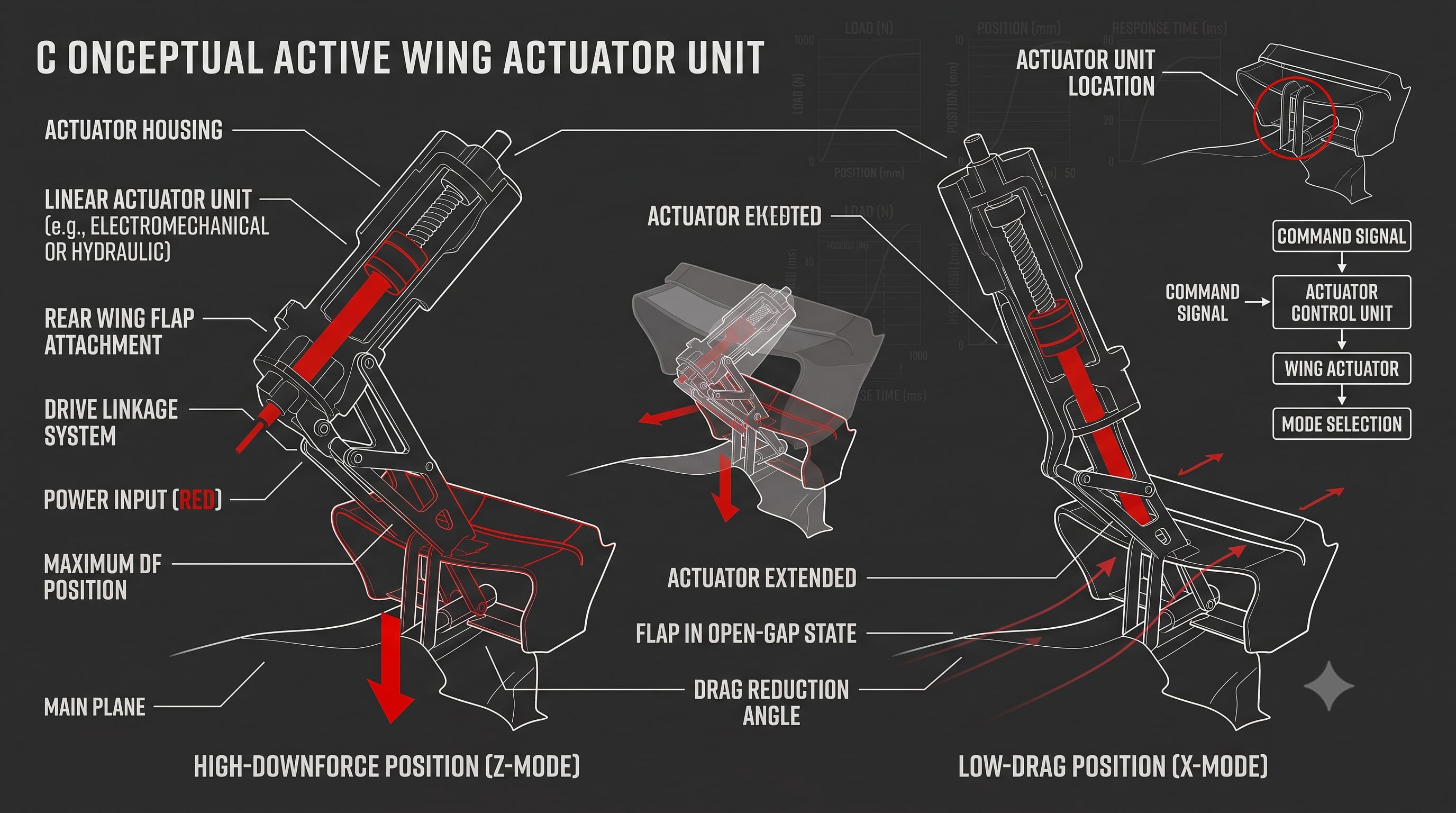
Both the front and rear wings carry movable elements, and they work as a pair between two configured states:
- Z-mode - high downforce. The wings sit in their full-grip shape for braking and cornering.
- X-mode - low drag. The elements flatten out on the straights, cutting drag so the car carries more speed for the same energy.
The driver selects X-mode on the straight; the car automatically snaps back to Z-mode the instant the brakes are touched. The front wing moving in concert with the rear is the genuinely new part - it keeps the aerodynamic balance stable as the car switches states, which a rear-only system (like DRS) never had to manage.
“DRS gave you one flap and one zone. Now the whole car breathes down every straight - and so does the car ahead of you.”
The crucial difference from DRS
DRS was a combat tool. You only got to open the flap if you were within one second of the car ahead, in a designated zone. It was an overtaking aid handed to the chaser.
Active aero is not that. Every car runs X-mode on every straight, all race long, whether or not anyone is ahead of it. The low-drag mode is a lap-time tool, not a passing tool. That removes the artificial “DRS train” dynamic - but it also removes the guaranteed closing speed a following car used to get. If overtaking were left there, 2026 would have made passing harder.
So how do you overtake now?
The passing aid moved from the wings to the battery. In place of DRS, a following car gets a manual override - a short burst of extra electrical deployment, triggered when you’re close enough behind. It hands the chaser power, not grip: a few hundred extra kilowatts down the straight rather than a slug of free downforce reduction.
The live debate of the season is whether that trade produces better racing. Power-based overtaking rewards a car that can put energy down cleanly out of the preceding corner; aero-based overtaking rewarded raw straight-line slip. Early returns are mixed - the racing looks more natural where the battery has charge to spend, and noticeably flatter where energy-poor cars arrive at the straight with nothing left in the override.
Why some weekends barely show it
Active aero’s value scales with how much straight a circuit has. On a layout full of long full-throttle runs, X-mode is worth a fortune and the override is decisive. On a tight, low-speed track it barely registers - there’s no straight long enough to matter, and qualifying position becomes everything.
That’s why the 2026 storyline has swung circuit to circuit. At low-speed venues like Monaco the system all but disappeared and track position ruled; at the Red Bull Ring, with three short straights each ending in a heavy stop, the cars that deployed cleanly out of the slow corners carried the day. Same regulations, completely different weekend.
The hidden cost: driver workload
DRS was one button in one zone. Active aero is a mode the driver manages lap after lap, woven into the same energy budget that the power unit already made the hardest puzzle on the car. When to hold Z-mode for stability, when to commit to X-mode and trust the front to follow, when to spend the override and when to bank the charge for defence - it’s a constant, lap-long calculation.
It is, in other words, of a piece with the rest of 2026: less of the performance handed to the driver by a single button, more of it earned by managing a car that asks a question on every straight. Whether that makes for better racing than DRS is the argument that will define how this rule set is remembered. Whether it makes for harder racing isn’t in doubt.