
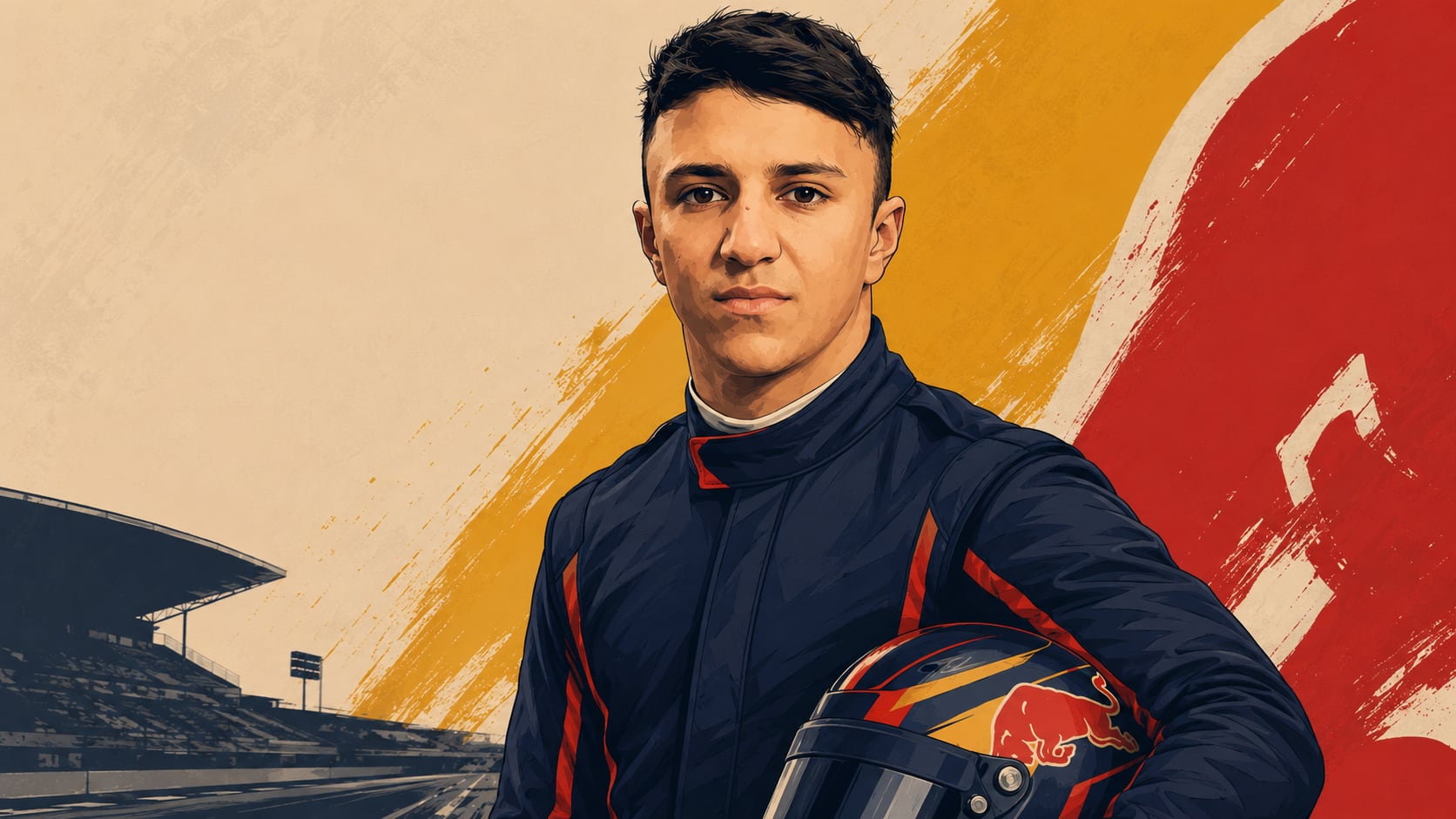
The two most-hyped graduates of 2025 are both still on the grid, both still young, and both having very different second seasons. One of them, Andrea Kimi Antonelli , is leading the championship by 40 points and getting every column inch the sport has to give. The other is eighth, says very little, and is quietly doing one of the most underrated jobs on the grid.
Isack Hadjar is not a rookie - that was 2025, his debut year at Racing Bulls. What he is, in 2026, is a second-year driver promoted into the hardest seat in Formula 1 to be judged from, sitting on 42 points next to a four-time world champion in a car that, on the evidence of eight rounds, is only the fourth-fastest on the grid.
Le Petit Prost: the junior CV
Hadjar didn’t arrive from nowhere. French media nicknamed him “le Petit Prost” during his junior career, and the results explain why. The short version of a long climb:
- Karting in Paris from the age of seven, onto the international scene by 2017 and the Karting World Championship by 2018.
- French F4, 2020 - third in the championship with the FFSA Academy.
- Formula Regional European, 2021 - fifth, with multiple wins, in his first year at the level.
- FIA Formula 3 and Formula Regional Asia with Hitech, 2022 - race wins in both, third in the FR Asia standings.
- FIA Formula 2, 2023–2024 - and in 2024, championship runner-up with Campos, beaten to the title only by Gabriel Bortoleto .
A Red Bull junior since 2022, that F2 runner-up season earned him the 2025 seat at Racing Bulls. A year later he was promoted again, into the senior team alongside Max Verstappen . Drivers do not get that call by accident.
The heritage
Hadjar was born in Paris in 2004 to an Algerian family of physicians and physicists, and holds dual Algerian and French citizenship. In a sport that has had vanishingly few drivers of North African heritage, that matters: he is one of the most prominent Algerian-rooted figures Formula 1 has ever put on a grid, and a name a whole region now follows on Sundays. The “le Petit Prost” tag nods to French racing royalty; the fuller story is more interesting than a nickname.
The season in one chart
The shape tells the story: a slow, painful start, then a hard turn upward. The first four rounds returned a single points finish. The last four have returned four - P5, P4, P6, P6 - and 38 of his 42 points. Whatever clicked around Canada, it has stayed clicked.
The bad start that wasn’t really his
It’s worth being precise about that opening run, because the headline - “one points finish in four” - flatters the car and not the driver. Hadjar qualified third in Australia, out-qualifying his champion teammate, and then retired from a points position. At Miami he started last after a weekend that went wrong before the lights, and retired again. Strip out the two DNFs - neither a straightforward driving error - and what’s left is a driver who was on the pace from the first Saturday of the year.
The quiet rounds in between (China, Japan) were the part that still looked like a work in progress: in the points once, out of them once, getting on terms with a 2026 car whose energy-management demands have caught out drivers with a decade more experience.
The Verstappen problem
Every measurement of Hadjar runs through the same filter: Max Verstappen , in identical machinery. That is the most unforgiving reference point in the sport, and it is worth being honest about what it shows - Verstappen has 73 points to Hadjar’s 42, and across a full season that gap is real, not noise.
But look at where Hadjar has closed it. Through the last four rounds he has finished P5, P4, P6 and P6; Verstappen, across the same four, has a podium and a scattered set of results shaped as much by Red Bull’s car as by his own driving. At Monaco - the one circuit where there is nowhere to hide and a mistake ends the weekend - Hadjar finished fourth, his best result of the year, while the other side of the garage retired:
That is the result that changed how the paddock talks about him. Before Monaco, Hadjar was the number-two in Verstappen’s Red Bull. After it, he was the answer to the question Red Bull have quietly been asking for two years - whether anyone other than Verstappen can extract a result from their car.
Austria: more of the same, which is the point
Spielberg wasn’t a breakthrough. It was a sixth place from eighth on the grid, on the lead lap, ahead of a recovering Lando Norris and both Ferraris on race pace through the middle stint. The flashy weekends get the headlines; the drivers who score every single time get the seats. Hadjar, right now, is doing the second thing.
What it adds up to
He will not finish 2026 as the standout young driver of the year - Antonelli has made that a closed contest. But the gap between the two stories is mostly the gap between their cars. One landed in the fastest seat on the grid; the other landed next to a generational champion in a car fighting for fourth, and has spent the back half of the season turning “promising junior” into “dependable Formula 1 driver.”
The career page reads 42 points and no podium. The driver underneath it - Paris karting, F2 runner-up, “le Petit Prost” - has only just got started.