

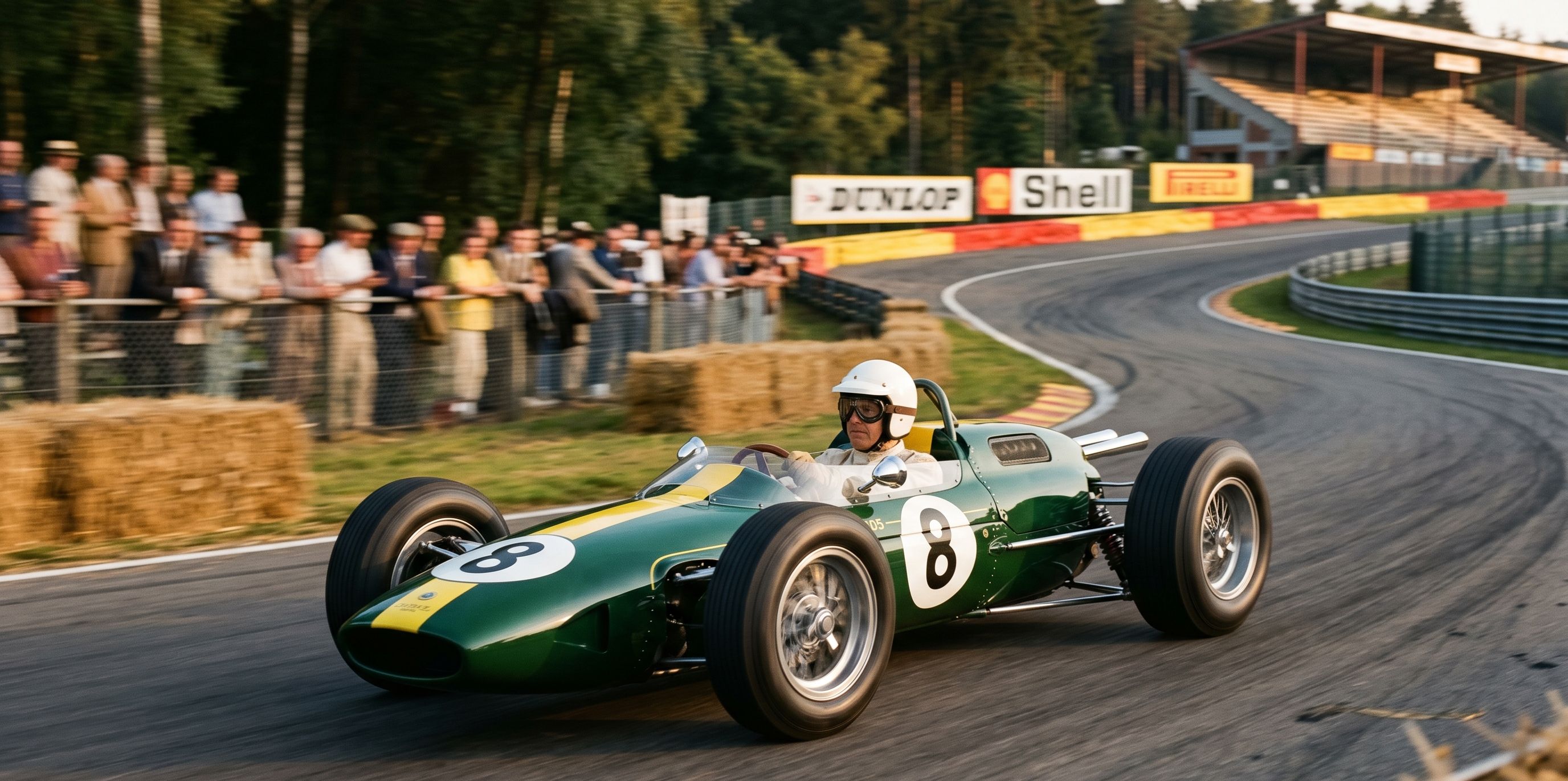
If you list F1 champions by win rate, the top of the table looks roughly like you’d expect: Juan Fangio , Alberto Ascari , Lewis Hamilton , Max Verstappen . And then - second only to Fangio - there’s Jim Clark .
Clark won 25 of his 73 starts. That’s a 34.2% win rate, behind only Fangio (47%) and Ascari (40.6%), and ahead of every modern driver. He took 34 poles from those 73 starts - a 46.5% rate that nobody since has come close to over a full career. And he won two championships (1963, 1965) when the calendar was 9–10 races long and a single retirement could swing a season.
The headline number tells the whole story. The detail is more interesting.
1963: seven wins from ten
1963 is, by any reasonable measure, the most dominant season in F1 history. Clark started ten races, retired with a gearbox failure at Monaco, and then won seven of the other nine:
70% wins from started races, 78% wins from finished races. The closest single-season figures in the modern era - Max Verstappen ‘s 19-from-22 in 2023, Michael Schumacher ‘s 13-from-18 in 2002, the Hamilton dominant years - top out around 70% from finishes. Clark did it on unforgiving cars, against drivers he respected, on tracks where a mistake killed you.
He clinched the title at Monza with three rounds to spare.
1962: the title he lost on the final lap
Read the 1962 championship table and the standings look close: Graham Hill on 42, Clark on 30. The reality of that season is that Clark was leading the final race - the South African Grand Prix at East London, with the championship on the line - when an oil leak slowed him to a stop. Hill took the win and the title.
Clark led 71 of the first 71 laps. The Lotus 25’s engine had been overfilled with oil at the pre-race service; it dribbled out for an hour before sufficient damage forced retirement on lap 62 of 82. Three more laps and it would have run to the flag.
1965: Indy 500 winner, F1 champion, six wins from seven
The 1965 season ran ten rounds. Clark skipped Monaco to fly to America and win the Indianapolis 500 - the first non-American to do so since 1916 and the first driver to win it in a rear-engined car. He then returned and won the next six F1 races in a row:
Title clinched at the Nürburgring with three races still to run. The Lotus team didn’t bother developing the car for the last three rounds; Clark retired from two and finished tenth in the other. Final tally for his races that mattered: six wins from seven F1 starts, plus the Indy 500.
Why he doesn’t get talked about more
Clark drove for Lotus exclusively. The cars were fragile - every Clark season has at least one DNF that wasn’t his fault. He was quiet, polite, Scottish-farmer modest, and he died young: killed at Hockenheim in April 1968, in a Formula 2 race, aged 32. He had won the South African Grand Prix opener that January - his 25th and last F1 victory, breaking Fangio’s all-time record.
Modern drivers compete in seasons of 22+ rounds with bulletproof cars. Clark got 73 starts in nine seasons. Project his win and pole percentages over a modern career and the numbers stop looking impressive and start looking absurd: ~75 wins, ~100 poles. Three or four titles, easily, if reliability had ever been on his side.
The career stats tab on the driver page gives the headline: 73 starts, 25 wins, 34 poles, 2 titles. The story underneath those numbers is of one of the most complete drivers F1 has ever had, in a era that didn’t forgive a single mistake.