

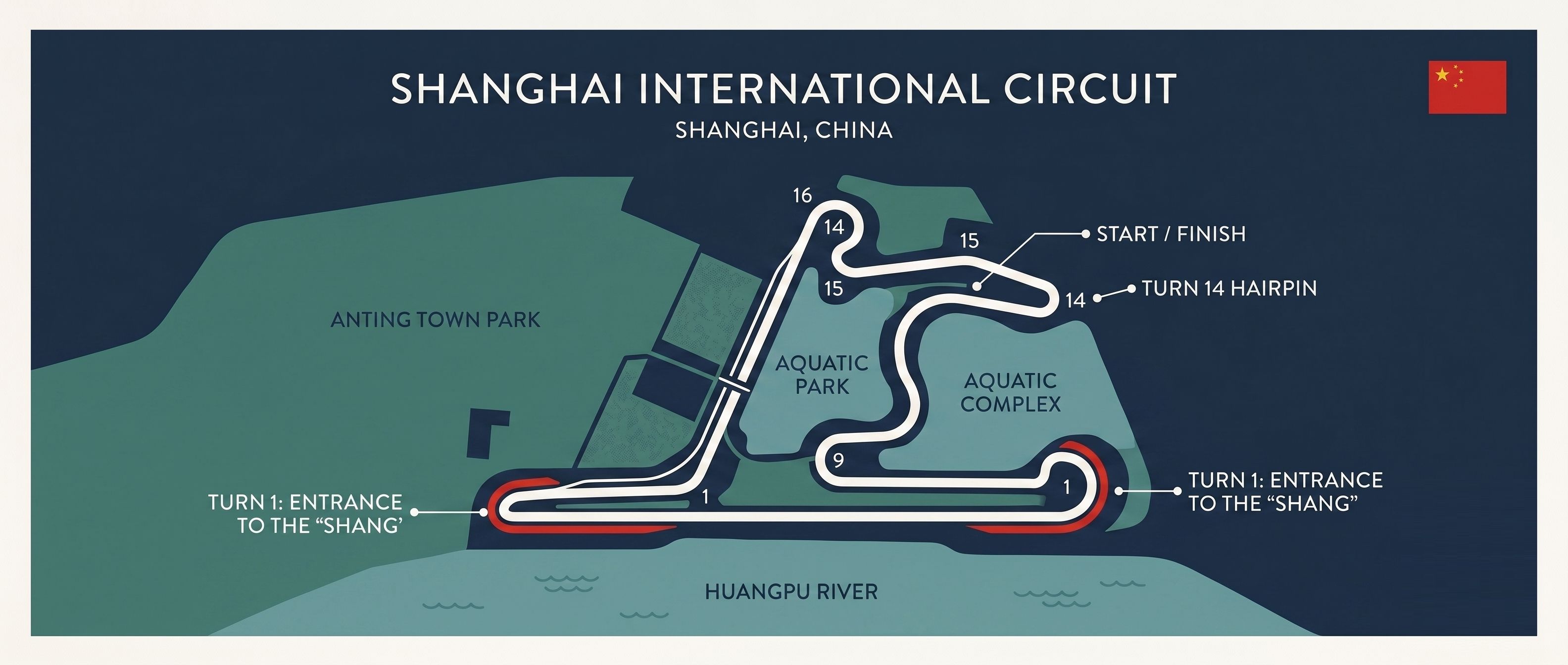
Shanghai gets the season’s first sprint format on March 13-15. One hour of practice on Friday morning, sprint qualifying that evening, a 100km sprint Saturday afternoon, full qualifying Saturday evening, race Sunday afternoon. Two race results banked in three days. It’s a format that rewards teams who turn up with a finished car and punishes teams still unpicking what their car is.
The Mercedes question
Melbourne wasn’t a one-off. The W17 spent the entire race controlling pace at the front, and the long-run gap to Charles Leclerc ‘s Ferrari was big enough that a different circuit, different temperature and different tyre compound shouldn’t bridge it. Shanghai’s medium-temp asphalt and long right-handers reward a car that’s stable on entry and easy on the rear - both W17 strengths in testing. If Mercedes are 1-2 here too, the title fight starts to look one-sided very early.
The other storylines
Red Bull went home from Melbourne with a long list of correlation work to do. A sprint weekend is the worst possible setting for a team that wanted three hours of practice to fix their car. He’ll grid up wherever the car can put him.
Oscar Piastri ’s lap-one spin in Australia was the kind of result that triggers internal reviews. Shanghai is the chance to draw a line under it.
Six wins in Shanghai across his career, more than any active driver. In a Ferrari that qualified third in Melbourne, on a track that rewards experience reading the surface, this is the weekend the move starts to make sense or doesn’t.
8 for the sprint winner, scaling to 1 for eighth. In a championship that already looks like Mercedes’ to lose, banked points in March matter more than they look like they should.
What to watch on Friday
The single-hour practice tells you which teams have brought upgrades that work and which have brought ones that don’t. Watch the long-run times late in the session - that’s the only honest race-pace data anyone gets before sprint qualifying.
Sprint Saturday at 11:00 local, Grand Prix Sunday at 15:00 local (07:00 UTC).